Impressions are up. Clicks are falling. ROAS is softer than it was 18 months ago.
This is not a bidding problem or a competitor issue. It is a structural shift in how search results pages work, and it is hitting every Google Ads account, across every vertical, at different rates.
PPC in the zero-click search era runs on different rules. More queries are resolved directly on the SERP. Fewer users click through to any website. The advertisers still generating strong returns have restructured their targeting, tightened their landing pages, and rebuilt their measurement models around outcomes rather than clicks.
This guide covers exactly how to win PPC in the zero-click search era: what has changed, what your competitors are already doing about it, and what you should do next.
What Is Zero-Click Search and What Does It Mean for PPC
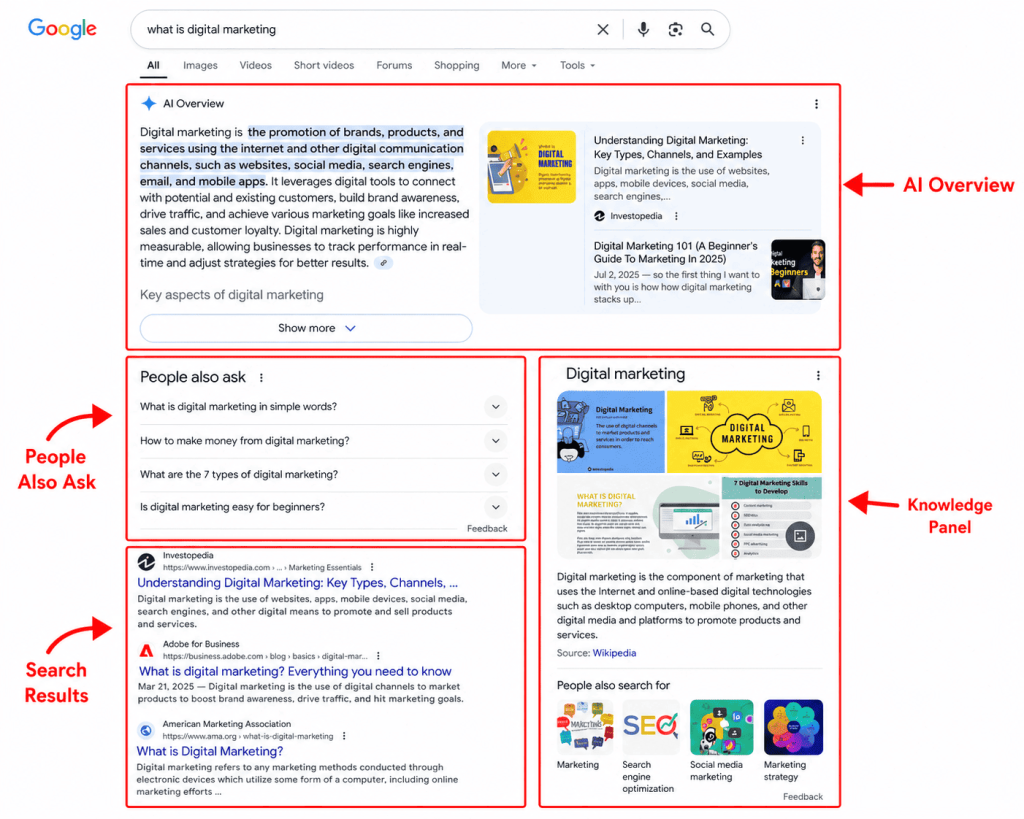
Zero-click search is any query where the user gets their answer directly on the results page, without visiting any website. Featured snippets, knowledge panels, People Also Ask boxes, and Google AI Overviews all deliver information in-SERP, eliminating the need to click through to any site.
According to a 2024 study by SparkToro and Datos (a Semrush company), 58.5% of US searches and 59.7% of EU searches ended without any click. For every 1,000 searches in the US, only 360 clicks reached any external website. That number continues to decline.
On mobile, the gap is even wider. According to Up and Social’s research, 77% of mobile searches end without a click, compared to 46.5% on desktop. Google’s mobile interface is built around immediate answers, and users on phones have increasingly little reason to click anywhere.
For PPC, the practical result is this: when a query is resolved by an AI Overview or featured snippet, there is no available click for your ad to capture, regardless of your bid. The total click pool has shrunk. The users who still click tend to be further along in the purchase process. Both facts require a different campaign structure than what worked before AI Overviews became mainstream.
The Google AI Overviews Ad Equation
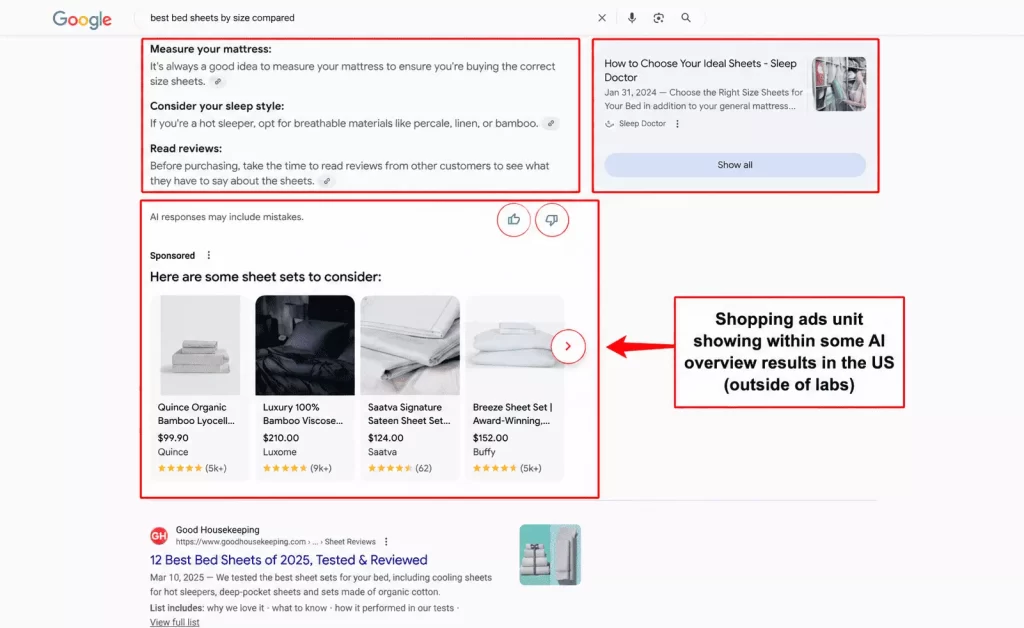
Google AI Overviews are AI-generated summaries appearing at the top of search results for complex, multi-part, or exploratory queries. They launched in the US in 2024 and have continued expanding globally through 2025 and into 2026.
As of March 2025, Semrush analysis of over 10 million keywords found AI Overviews appeared on 13.14% of all US desktop queries, up from 6.49% in January 2025, a doubling in just two months. BrightEdge confirmed the expansion is heavily skewed toward longer, conversational queries. Ahrefs research from April 2025, covering 300,000 keywords, found a 34.5% reduction in organic clicks for top-ranking pages when AI Overviews appear.
For paid search, the relationship is not simply competitive. According to Google Ads Help, your existing Search, Shopping, and Performance Max campaigns are already automatically eligible to appear above, below, and within AI Overview responses. No opt-in is required.
One critical restriction advertisers need to know: Google currently excludes sensitive verticals from AI Overview ad placements, including healthcare, finance, and certain other regulated categories. If you run campaigns in these verticals, your ads appear around AI Overviews rather than within them. This changes the strategic approach for those accounts significantly.
For campaigns outside restricted verticals, ads within AI Overviews are matched using both the user’s original query and the content of the AI-generated summary. An ad that is perfectly matched to a keyword may not appear if it is not relevant to what the AI Overview actually covered. Relevance is now assessed at two levels simultaneously.
Google is also testing a separate placement: AI Mode, a conversational interface for complex, multi-step queries. Ads appear below AI Mode responses when relevant. This is different from AI Overview ads and targets users deeper in a research journey, making it a mid-funnel opportunity with no previous paid inventory. Both placements run through Search, Shopping, and Performance Max campaigns. Performance Max is worth flagging specifically: because it distributes budget across all Google surfaces using AI-driven allocation, it is the campaign type best positioned to capture AI Overview and AI Mode placements as they expand through 2026.
Where Your Campaigns Are Most Exposed
Zero-click search does not affect all campaigns equally. The exposure concentrates on specific query types, and identifying yours is the first step.
Informational queries, those asking what something is, how something works, or why something happens, are the highest-risk category. These trigger AI Overviews most frequently. Seer Interactive’s November 2025 analysis of 3,119 search terms across 42 organisations found that organic CTR for informational queries fell 61% from mid-2024 onwards. Paid clicks on these queries are similarly affected.
Commercial and transactional queries sit in a different position entirely. Searches like “Google Ads management pricing,” “dental implants near me,” or “best CRM for small business” are rarely answered by AI Overviews. A user with genuine purchase intent still needs to go somewhere to book, buy, or speak to someone. AI cannot process a payment, submit a form, or confirm an appointment on their behalf.
The fastest diagnostic is your Search Terms report. Look for keywords with rising impression share and flat or declining CTR. That pattern is the footprint of AI Overviews absorbing attention your ads previously received.
The Quality Score Cascade Most Advertisers Are Missing
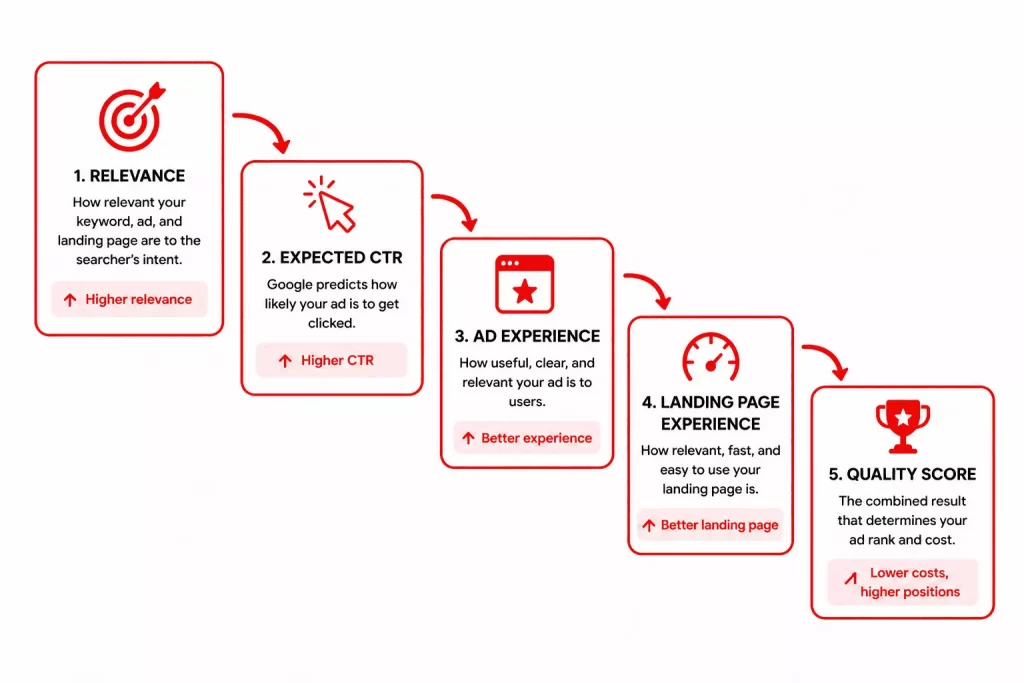
This is the part most PPC guides skip over, and it matters for your costs.
When AI Overviews appear on a query, total CTR across the page falls. Your ad’s CTR drops alongside it, even if your ad position is unchanged. Because expected CTR is a core component of Quality Score, a sustained fall in CTR on affected queries drags down your Quality Score over time. Lower Quality Score means higher CPC. So zero-click search does not just reduce click volume, it actively drives up the cost of the clicks you do receive.
The compounding effect: fewer clicks, at higher cost, from a smaller pool of available inventory. This is why accounts with broad keyword targeting across informational queries often see ROAS deteriorate without any obvious cause in the campaign settings.
The structural fix is the same as the campaign fix: concentrate budget on commercial intent keywords where AI Overviews rarely appear, maintain strong ad copy relevance, and keep landing pages tightly aligned to query intent. These actions improve expected CTR, protect Quality Score, and break the cost spiral. Keeping track of the right Google Ads KPIs through this shift is essential, because standard CTR benchmarks no longer tell the full story.
Nine Adjustments That Protect PPC Performance in 2026
1. Move Budget to Commercial Intent Keywords
Informational keywords were always a soft bet in PPC. The zero-click era makes that undeniable.
Audit your keyword list for commercial intent signals. Queries containing “pricing,” “near me,” “hire,” “book,” “buy,” “best [specific product or service],” and “[service type] for [location or industry]” identify users past the research phase. These searches are most likely to produce a click and most likely to convert when they do.
Negative keywords are your control mechanism. Review the Search Terms report weekly. Any query that reads like a research question rather than a purchase signal belongs on the negative list. This protects CAC and keeps Smart Bidding calibrated to revenue-generating traffic rather than curiosity traffic.
Ad group structure matters more now than it did two years ago. Tightly themed ad groups, where each group covers one distinct service rather than a cluster of related keywords, produce stronger ad-to-query relevance. That relevance is what Google evaluates when deciding which ads to surface in AI Overview placements. Catch-all ad groups produce lower Quality Scores in a standard auction. In an AI-matched auction, they are even less competitive.
2. Use Broad Match With Smart Bidding the Right Way
Google’s own guidance on ads in AI Overviews specifically recommends broad match or keywordless targeting to capture the varied, conversational queries that AI-generated results attract. This is not a blanket recommendation to run broad match without controls.
Broad match paired with Smart Bidding and a clearly defined conversion goal gives Google’s algorithm room to match your ads to long-form, conversational queries that exact match misses entirely, without spending indiscriminately. In Q2 2025, non-brand broad match keywords had nearly closed the performance gap with exact match, with the ROAS difference at its smallest recorded level.
The variable that makes or breaks this approach is conversion data quality. Smart Bidding optimises toward whatever you define as a conversion. If that is a raw form fill, it finds form fillers. If it is a qualified sales call or a CRM-confirmed deal, it finds those. Optimise toward your actual business outcome, not a proxy metric.
There is also a bidding shift worth making. Users who click through after reading an AI Overview are already informed and actively choosing their next step. These clicks carry higher conversion likelihood and higher value. That makes tROAS a stronger choice than tCPA for commercial intent campaigns. When Smart Bidding targets return on ad spend rather than a flat cost target, it allocates more budget toward the high-value clicks that zero-click search has concentrated into the pool, and pulls back from lower-value ones.
3. Maximise Your Ad Real Estate
As AI Overviews compress the visible paid inventory on a SERP, the physical space your ad occupies becomes more important than ever.
Fill every available headline and description slot in your Responsive Search Ads. Use all available ad assets: sitelinks, callouts, call assets, structured snippets, and lead form assets where relevant. The more screen space your ad occupies, the more likely it captures attention from users who do click.Maximising ad assets also improves Ad Strength, which Google considers alongside Quality Score when determining Ad Rank. See how Google Ad extensions contribute to campaign performance for the full framework on building this out correctly.
4. Build Transactional Landing Pages
The users who click through in a zero-click search environment have typically already read a SERP-level summary of the topic. They are not looking for an explanation of what your service is. They clicked because they want to do something: book, buy, or speak to someone.
A landing page built to educate will not convert a user who has already been educated and clicked through to act.
Remove introductory content that duplicates what an AI Overview already covered. Lead with the offer, the booking mechanism, or the specific product. Put the conversion action above the fold. If your primary goal is phone calls, the number goes at the top of the page. If it is a form submission, the form should be reachable without scrolling.
This also improves the landing page experience component of Quality Score, which affects both CPC and Ad Rank on every query, including eligibility for AI Overview placements.
5. Layer Audience Signals to Concentrate Spend
A smaller click pool makes every click more expensive to waste. Audience layering puts your budget in front of users most likely to convert.
In-market audiences identify users actively researching your product or service category. Remarketing lists target users who have already visited specific pages on your site. Customer Match lets you reach users already known to your business, including past clients and high-value prospects.
Each signal allows you to bid more aggressively for users closer to a decision and pull back on users with lower conversion probability. In the zero-click era, this is not just a targeting refinement. It is a structural efficiency mechanism. Fewer total clicks means the distribution of your spend within that pool matters far more than it did when volume was higher.
First-party data becomes the highest-ROI targeting lever as CPCs rise. Your own customer lists and CRM data are the most accurate signal for identifying who is worth bidding for. Advertisers with Customer Match data integrated with Smart Bidding absorb CPC inflation better than those relying on Google’s third-party signals alone. Building that data asset now is a compounding advantage as click costs continue rising.
For lead-generation accounts, layering in-market audiences over broad match campaigns with tCPA or tROAS bidding is one of the most reliable ways to maintain CAC discipline as total click volume contracts. Our Google Ads management team uses this combination as a default starting point for high-volume service accounts.
6. Know the Healthcare and Finance Exception
If you advertise in healthcare, dental, fertility, finance, or other regulated verticals, your campaigns are currently excluded from AI Overview ad placements by Google’s policy.
This is not a Quality Score issue or a bid issue. It is a categorical restriction. Your ads can still appear above and below AI Overviews on affected queries, but not within the generated summary itself.For these verticals, the focus shifts entirely to maximising placement quality on commercial intent queries, keeping ad copy hyper-specific to the service being searched, and building landing pages that convert the higher-intent traffic that does click. If you run dental PPC campaigns or healthcare PPC more broadly, this restriction directly shapes your campaign architecture.
7. Rebuild Your Measurement Model
Clicks and CTR alone are no longer sufficient performance indicators. In a zero-click environment, an ad that generates strong impression share in AI-adjacent placements may show lower CTR than a tightly themed exact match campaign. Judged by CTR alone, it looks underperforming. Judged by downstream outcomes, it may be generating significant brand awareness.
Track cost per qualified lead, CAC, ROAS, branded search volume trends, view-through conversions, and direct traffic patterns. These metrics capture the downstream value of impressions that do not immediately produce a click.
The accounts winning in 2025 and 2026 are measuring influence, not just traffic. In practice this means setting up a branded vs non-branded split in Google Search Console, tracking impressions and clicks separately for each segment. In GA4, a custom channel group separating assisted from last-click conversions shows how many leads touched a paid impression before converting elsewhere. These two data sources together tell a more complete story than CTR and click volume alone. The key Google Ads performance metrics for 2025 and 2026 have shifted, and your reporting dashboards need to reflect that.
Conclusion
Zero-click search is not the end of paid search. It is the end of paid search on autopilot.
The advertisers losing ground share the same profile: broad keyword targeting on informational queries, generic landing pages, and CTR as the primary success metric. The advertisers holding performance have moved budget to commercial intent, calibrated Smart Bidding to real revenue data, built landing pages for users ready to act, and rebuilt measurement around outcomes beyond the click.
The click pool is smaller. The users in it are higher intent. That is not a crisis. It is a filter that rewards accounts built around outcomes rather than volume.If you want to know exactly where your campaigns are exposed and what changes will protect your ROAS, book a free Google Ads audit with AdtoRise. We identify the specific gaps and build the plan to close them.
Frequently Asked Questions
Not uniformly. Informational queries are most affected. Commercial and transactional queries, the core of PPC for most businesses, are far less frequently answered by AI Overviews. Campaigns built around purchase-intent keywords remain effective. The change is that broad match campaigns capturing informational research traffic now produce fewer clicks from that segment.
No. Your existing Search, Shopping, and Performance Max campaigns are automatically eligible, subject to Google’s relevance assessment. Ad copy and landing page quality relative to both the user’s query and the AI Overview content determine your chances of appearing in this placement. There is no separate opt-in. Note that sensitive verticals including healthcare and finance are currently excluded.
Not if it is paired with Smart Bidding and a qualified conversion goal. Google’s own guidance on AI Overview placements recommends broad match or keywordless targeting to capture conversational, AI-driven query patterns. The risk is broad match without bidding controls, where spend drifts to irrelevant queries. Used with proper conversion tracking, broad match expands reach into the search patterns AI Overviews respond to without sacrificing ROAS discipline.
When AI Overviews reduce total CTR on a query, your ad’s expected CTR falls with it, even if your position is unchanged. Lower expected CTR is a component of lower Quality Score, which raises your CPC. This is the secondary cost pressure zero-click search creates beyond simply reducing click volume. Concentrating campaigns on commercial intent keywords where AI Overviews rarely appear limits this exposure.
Pull your Search Terms report and look for keywords with rising impression share and declining CTR. Those are queries where AI Overviews are absorbing attention. Also check landing page bounce rate on informational traffic. Rising bounce rate on those pages is consistent with users who got their answer at SERP level and clicked through without genuine intent to act.
No. Google does not offer an opt-out for AI Overview ad placements. Google determines placement eligibility based on relevance signals. Your ads will appear in these placements when they are relevant to both the user’s query and the AI-generated summary, and you meet the auction threshold.
AI Overviews are summary boxes at the top of standard search results. AI Mode is a separate conversational interface for deeper, multi-step queries. Ads in AI Overviews appear above, below, or within the summary. Ads in AI Mode appear below the conversational response. Both run through existing Search, Shopping, and Performance Max campaigns. AI Mode is currently testing in the US and represents new mid-funnel inventory that did not previously exist in paid search.
Move beyond clicks and CTR. Track cost per qualified lead, CAC, ROAS, branded search volume, view-through conversions, and direct traffic patterns. These capture downstream value from impressions that do not immediately produce a click.
Since healthcare and dental verticals are currently excluded from AI Overview placements, the priority is maximising performance on commercial intent queries where standard ad placements still dominate. Hyper-specific ad copy, fast-loading transactional landing pages, and strong audience layering with in-market signals are the core levers. Both dental PPC and broader healthcare PPC strategies need to account for the exclusion zone when forecasting impression and click volumes.